Welcome to America's Optimistic futurist
Proven ways to improve kids' learning
without messing with teachers.

Need a Partner? Try the U.S. Department of Energy's Teaming Partner List.
Energy costs too high at your school? Learn about DOE's Qualified List of Energy Service Co's.
Contribute to The Pollution Detectives GoFundMe Giving Fund
NEW Subscriber? Find Past Newsletters, below!
Newsletter of the Week
Years ago, before moving to North Carolina I lived in Florida, where I spent decades working as an administrator in pediatric healthcare. Over one Christmas holiday, my kids and grandkids came to visit, and I treated them all to a one-day family centered ocean cruise. A peaceful start allowed people inside to dance and laugh at the little kids playing tag. The ocean became very rough, with 30-foot-tall waves and very high winds. The joy came to an abrupt halt when 30 miles off Miami the captain announced that the cruise ship was going stop to rescue a sinking boat and drowning passengers.
 We all rushed to the windows to see what was going on. We saw the cruise liner staff trying to connect a 20-foot-long rope ladder from the ship’s railing down to an old handmade wooden boat loaded with about 30 adults and children - Haitian refugee families trying to escape the violence and poverty of their homeland. We learned later that their boat motor had died, and they had been adrift for days with no food.
After what seemed to be hours of heroic effort by the ocean liner crew, the two-story rope ladder was connected, and people began to climb up. One man got almost to the top of the ladder and in front of his wife and several children fell down the ladder and disappeared into the sea.
Forever.
I helped the new widow and her kids to a stack of towels and clothes passengers had quickly assembled. As her 4 year old daughter clung to her knee, and numb with cold and grief, she wept his loss. He was, she said “a good man.”
The tension filled rescue attempt of the survivors continued, and as we circled around the sinking boat, some cruise passengers shouted that these Haitians should be left behind because the passengers who paid a lot of money for a safe voyage might be hurt by big waves while the crew tried to save the refugees, or that the refugees would take jobs from Americans, or they would carry a disease. Other passengers were silent.
After all the remaining refugees were on board, the survivors were placed in a large room below deck away from the rest of the passengers. Dinner time was full of tears and soft murmured conversation and did not include dancing.
I tried to pass a hat around the dining room to collect donations for the survivors – and was stopped by the ship’s officer. He told me that the story of the cruise passengers generosity would soon be shared with other members of the Haitian community, some of whom would try to get another old boat and hope to get as far as the shipping lanes where big boats and cruise liners traveled frequently, and where maritime law required them to stop and rescue them.
“We do not see two out of three of these little craft”, he said, “and your generosity will lure many more to their death”.
I think about that event often. Do we have an obligation to help the less fortunate? If being helpful to some creates the risk of harm to others, what should we do? With limited resources, how do we decide who, and how, to help? What kind of effort can we build that will deliver the greatest good possible? Should we let our critics force us from our well-intentioned path?
Over this gift-giving Christmas holiday, I still ask myself what those of us who are warm, dry, and well fed should do for those who are not.
Expert Endorsements for Indoor Air Quality
|
|
My books containing other success stories
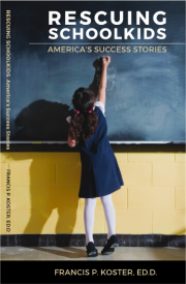
Written in 2015, this was my first attempt at celebrating successful actions taken by K-12 schools. Although the data is now outdated, the 22 concepts in this book are still valid, and worth a read. The website above will continue to add to that library - look on the right side for more recent role model stories.

We are living in an era when many Americans feel things are out of their control, which causes them frustration, anger, and depression. This book explains the theory and practice of how to influence the direction and growth of your local economy, and regain your power to protect your community and family. First published in 2016, the lessons remain accurate and powerful.
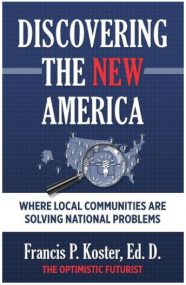
As a country, we are not without solutions. This collection, first published in 2013, takes a country-wide locally solvable view of significant issues which still exist, and in may ways have gotten worse since I first wrote about them. You, can solve these problems by imitating the behavior of the pioneer efforts cited here.
Don’t miss out on new content
Stay up to date with the latest articles, news, or books.
Francis P. Koster Ed.D.
Proven local solutions to national problems.
CONTACT
Copyright © 2023 America's Optimistic Futurist